
 国家社会科学基金学术期刊资助入选期刊
J. East China Norm. Univ. Philos. Soc. Sci ›› 2025, Vol. 57 ›› Issue (3): 147-162.doi: 10.16382/j.cnki.1000-5579.2025.03.014
Xiaopeng Hu
Accepted:2025-04-24
Online:2025-05-15
Published:2025-05-28
Xiaopeng Hu. Debt Structure,Domestic Debt Chains,and Modern Economic Growth:Theoretical Logic Based on Debt-Credit Linkages Among Three Sectors and Four Entities[J]. J. East China Norm. Univ. Philos. Soc. Sci, 2025, 57(3): 147-162.
"
| 公共部门(g) | 企业部门(c) | 家庭部门(h) | |
| 国内(d) | 主权内债:Ddg | 企业内债:Ddc | 民间债务:Ddh |
| 国外(f) | 主权外债:Dfg | 私人外债:Dfp | |
"
| 债权主体 | 债务部门 | ||
| 公共部门Ddg | 企业部门Ddc | 家庭部门Ddh | |
| 公共主体 | — | — | — |
| 金融主体 | 如银行贷款、购买国债, 以及隐形债 | 如银行贷款、金融机构购买 的企业债 | 如个人银行按揭,及金融 机构小额贷 |
| 企业主体 | 如企业购买国债 | 如企业间购买企业债 | — |
| 家庭主体 | 如个人购买国债 | 如个人购买企业债 | 如个人之间的欠债 |
"
| 家庭部门 | 公共部门 | 企业部门 | 债务 | |||||||
| 家庭 | 银行 | 政府 | 银行 | 企业 | 银行 | 规模 | ||||
| h1 h2 …… hn | B | G | B | e1 e2 …… em | B | 内债 | 外债 | |||
家庭 部门 | 家 庭 | h1 h2 … hn | 0, a12, …,…, a1n −a12, 0, …,…, a2n …, …, …, … −a1n, −a2n, …,…, 0 | Bh1 Bh2 … Bhn | −Gh1 −Gh2 … −Ghn | −b11, −b12,…,…,−b1m −b12 , −b22, …,…,−b2m …, …, …, … −bn1 , −bn2,…,…,−bnm | dh1 dh2 … dhn | oh1 oh2 … ohn | ||
| 银行 | B | −Bh1, −Bh2,…,…,−Bhn | 0 | −BH | OhB | |||||
| 公共部门 | 政府 | G | Gh1 , Gh2, …,…, Ghn | 0 | GB | Ge1 , Ge2, …,…,Gen | dG | OG | ||
| 银行 | B | −GB | 0 | −GB | ||||||
企业部门 | 企业 | e1 e2 … em | b11, b12, …,…, b1n b12 , b22, …,…, b2n …, …, …, … bm1 , bm2, …,…, bmn | −Ge1 −Ge1 … −Ge1 | 0, c12, …,…, c1m −c12 , 0, …,…,c2m …, …, …, … −c1m, −c2m, …,…,0 | Be1 Be2 … Bem | de1 de2 … dem | oe1 oe2 … oem | ||
| 银行 | B | −Be1, −Be2,…,…, −Bem | 0 | −Be | OeB | |||||
| 债权 规模 | 内债 | −dh1, −dh2,…,…,−dhn | BH | −dG | GB | −de1, −de2,…,…,−dem | Be | D内 −D内 | ||
| 外债 | −oh1, −oh2,…,…,−ohn | −OhB | − OG | −oe1, −oe2,…,…,−oem | −OeB | O外 −O外 | ||||
"
"
| 指标 | 性质 | 公式 | |
家庭 | 家庭对家庭债务( | 家庭部门内债权债务相互抵消 | |
| 家庭对企业债务( | 家庭可购买企业债, | ||
| 家庭对政府债务( | 家庭可以购买公债, | ||
| 家庭对银行债务( | 存款债权方。部门内有存有贷,不存在抵消 | ||
| 家庭国内债务链宽(DWh) | |||
企业 | 企业对企业债务( | 企业部门内债权债务相互抵消 | |
| 企业对家庭债务( | |||
| 企业对政府债务( | 企业可购买公债, | ||
| 企业对银行债务( | 存款债权方。部门内有存有贷,不存在抵消 | ||
| 企业国内债务链宽(DWe) | |||
银行 | 银行对家庭的债务( | 如果 银行是债务方 | 且 |
| 银行对企业的债务( | 如果 银行是债务方 | 且 | |
| 银行对政府债务( | 银行可购买公债, | ||
| 银行国内债务链宽(DWB) | |||
| 政府 | 政府对家庭债务( | ||
| 政府对企业债务( | |||
| 政府对银行债务( | |||
| 政府国内债务链宽(DWG) | |||
| 国民经济内债链宽(DW) | |||
"
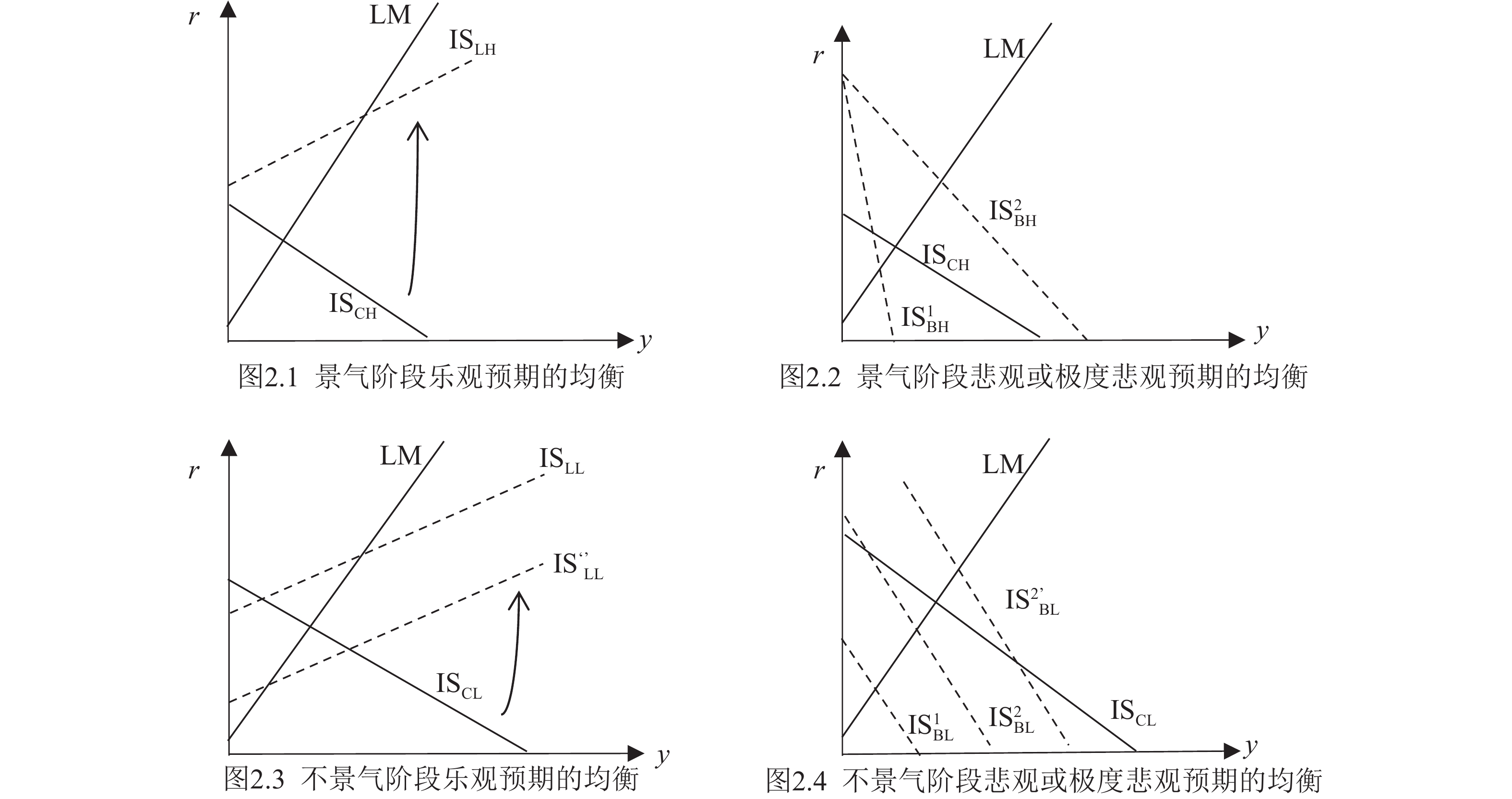
| 当前环境 | 不考虑预期和债务链 | 乐观预期 | 适度乐观或悲观预期 |
| H: | ISCH:纵轴截距A1, 斜率 | ISLH:纵轴截距A1不变 且绝对值小于 | ISBH:纵轴截距A1不变 绝对值大于 变大;与横轴y的截距说明见附录 |
| L: | ISCL:纵轴截距A2, 斜率 | ISLL:纵轴截距A2变小,斜率 且绝对值小于 | ISBL:纵轴截距A2变大 绝对值大于 与横轴y的截距说明见附录 |
| 景气H② | r0,y0 | r0提高,y0提高 | 适度的乐观和悲观时,r0提高,y0提高; 严重悲观时,r0降低,y0降低 |
| 不景气L | r1,y1 | r1不确定,y1不确定 | 赤字较低时,r1降低,y1降低; 赤字较高时,r1不确定,y1不确定 |
"
| 陈诗一、汪莉,2016,《中国地方债务与区域经济增长》 ,《学术月刊》 第6期,第37—52页. | |
| 高连奎,2023,《“政府债务—央行利率—金融投资—经济创新”传导机制理论——宏观经济学“通论式研究”新范式》 ,《时代经贸》 第2期,第62—65页. | |
| 高禄、车维汉、李立平,2019,《发展中国家国际债务资本开放的条件分析——基于国内债务水平的研究》 ,《国际金融研究》 第4期,第77—86页. | |
| 胡翠、许绍元,2011,《对外负债与经济增长》 ,《经济研究》 第2期,第19—30+58页. | |
| 纪园园、朱平芳、宁磊,2020,《家庭债务、区域差异与经济增长》 ,《南京社会科学》 第10期,第25—33页. | |
| 贾俊雪、郭庆旺,2011,《财政规则、经济增长与政府债务规模》 ,《世界经济》 第1期,第73—92页. | |
| 美]瑞·达利欧,2019,《理解重大债务危机的模板》 ,赵灿、熊建伟等译,北京:中信出版社. | |
| 沈雨婷,2019,《财政分权与晋升激励对地方政府债务影响研究》 ,《甘肃社会科学》 第1期,第172—178页. | |
| 田新民、夏诗园,2016,《中国家庭债务、消费与经济增长的实证研究》 ,《宏观经济研究》 第1期,第121—129页. | |
| 杨攻研、刘洪钟,2014,《不同类型债务对经济增长及波动的影响》 ,《经济学家》 第4期,第31—39页. | |
| 杨攻研、刘洪钟,2015,《债务、增长与危机:基于债务异质性的考证》 ,《经济评论》 第6期,第40—54页. | |
| 钟宁桦、刘志阔、何嘉鑫、苏楚林,2016,《我国企业债务的结构性问题》 ,《经济研究》 第7期,第102—111页. | |
| 朱文蔚,2020,《地方政府债务融资的理论逻辑、演化特征及发展态势》 ,《福建论坛(人文社会科学版)》 第5期,第77—87页. | |
| Cecchetti,G.S.,Mohanty,M.S. and Zampolli,F.,2011,"The Real Effects of Debt",BIS Working Paper,No. 352. | |
| Fisher,I. ,1993,“The Debt-Deflation Theory of Great Depressions”,Econometrica,No. 4:337-357. | |
| Koo,R. C. ,2008,The Holy Grail of Macroeconomics:Lessons from Japan's Great Recession,Singapore:John Wiley and Sons (Asia). | |
| McKinnon,R. I. ,1973,Money and Capital in Economic Development,Washington DC:The Brookings Institution. | |
| Minsky,H. ,1982,“Debt-Deflation Processes in Today's Institutional Environment”,Banca Nazionale del Lavoro Quarterly Review,No. 143:375-395. |
| [1] | Yu-chun YAO, Bing LI. On the Transformation of China’s Economic Growth Drivers in the New Development Stage: Logic, Direction and Path [J]. Journal of East China Normal University (Philosophy and Social Sciences), 2022, 54(3): 161-171. |
| [2] | YUE Hua, ZHANG Hai-jun. Financial Development, Resource Curse and Economic Growth [J]. Journal of East China Normal University (Philosoph, 2019, 51(6): 138-150. |
| [3] | HU Yan, PAN Ting, ZHANG Wei. On the Economic Growth Effect of the Coordinated Innovation of the Yangtze River Delta Urban Agglomeration under the Integrated National Strategy [J]. Journal of East China Normal University (Philosoph, 2019, 51(5): 99-106. |
| [4] | DONG Zhi-Qing,SONG Wei,ZHAO Jing. Technology Gap, Convergence of Economic Growth: Empirical Test Based on Provincial Panel Data [J]. Journal of East China Normal University (Philosoph, 2015, 47(6): 129-139. |
| [5] | CHEN Xiao-jing. An empirical study on the relationship between tourism development and economic growth—a panel data analysis of the EU case [J]. Journal of East China Normal University (Philosoph, 2015, 47(3): 102-109. |
| [6] | GONG Xiu-Guo, CAI Ruo-Fan. Empirical Study of the Impact of the US Exchange Rate Strategy on China’s Inflation [J]. Journal of East China Normal University (Philosoph, 2014, 46(3): 107-112. |
| [7] | Xiong Xianghua. Language Expectation and Language Variation in Rural Areas in the Process of Urbanization: Based on an Investigation of Huaxi Dialect Pronunciation [J]. Journal of East China Normal University (Philosoph, 2013, 45(4): 27-33. |
| [8] | LONG Cui-Hong. The Nexus of Income Gap, Economic Growth and Educational Inequality in China [J]. Journal of East China Normal University (Philosoph, 2011, 43(5): 138-144. |
| [9] | CHEN Ti-Biao, RAO Xiao-Hui. Transitional Dynamic Characteristics of Economic Growth in China’s Some Provinces [J]. Journal of East China Normal University (Philosoph, 2011, 43(5): 125-131. |
| [10] | Su Zhi-fang. The Source of China’s Expected Inflationary Uncertainty and Its Impact on Macro Economy [J]. Journal of East China Normal University (Philosoph, 2011, 43(1): 39-47. |
| [11] | Xue-jun FAN. The Stock Market and Economic Growth: An Analysis Based on Asymmetric Information [J]. Journal of East China Normal University (Philosophy and Social Sciences), 2007, 39(4): 119-124. |
| [12] | Gui-xin WANG, Xin-ya MAO, Yi-na ZHANG. The Population Migration and Economic Polarized Growth in Three Metropolitan Regions of East China [J]. Journal of East China Normal University (Philosophy and Social Sciences), 2006, 38(5): 1-9. |
| [13] | Xue-jun FAN, Lensink Robert, Jacobs Jan. Chicken or Egg: Financial Development and Economic Growth in China, 1992—2004 [J]. Journal of East China Normal University (Philosophy and Social Sciences), 2006, 38(2): 102-107. |
| [14] | Jian-qing LU, Guang-jing WU, Lan SHEN. A Study on the Investment Decision-making Model of Chinese Business Managers [J]. Journal of East China Normal University (Philosophy and Social Sciences), 2005, 37(4): 89-94, 123. |
| Viewed | ||||||
|
Full text |
|
|||||
|
Abstract |
|
|||||
