
 国家社会科学基金学术期刊资助入选期刊
J. East China Norm. Univ. Philos. Soc. Sci ›› 2026, Vol. 58 ›› Issue (2): 160-171.doi: 10.16382/j.cnki.1000-5579.2026.02.014
Jian Li, Huayu Xie, Mingyang Ju
Accepted:2026-02-09
Online:2026-03-15
Published:2026-03-31
Jian Li, Huayu Xie, Mingyang Ju. The Impact of National Innovative City Pilot Policy on Urban Economic Resilience[J]. J. East China Norm. Univ. Philos. Soc. Sci, 2026, 58(2): 160-171.
"
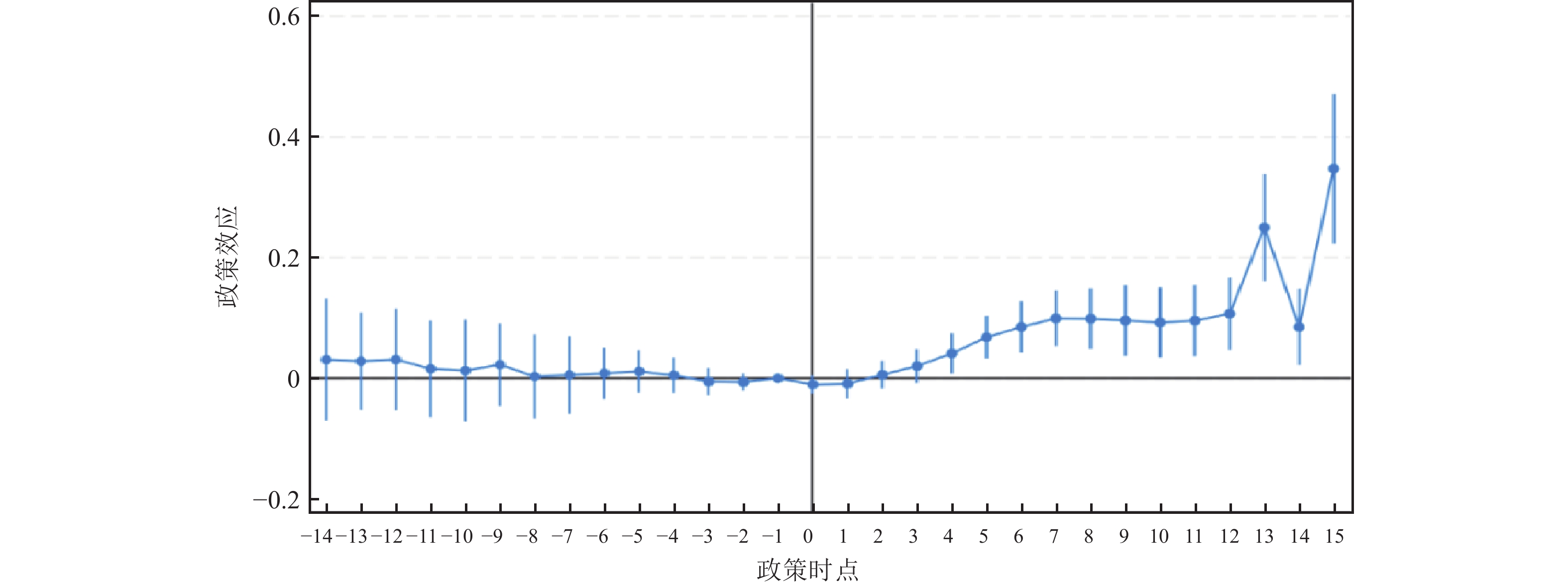

"
| 变 量 | (1) Lasso | (2) Lasso | (3) Elastic Net | (4) Elastic Net | (5) Svm | (6) Svm |
| DID | 0.024** (0.011) | 0.026*** (0.009) | 0.031*** (0.011) | 0.025*** (0.009) | 0.042*** (0.014) | 0.067*** (0.015) |
| 控制变量一次项 | YES | YES | YES | YES | YES | YES |
| 控制变量二次项 | NO | YES | NO | YES | NO | YES |
| 城市固定效应 | YES | YES | YES | YES | YES | YES |
| 时间固定效应 | YES | YES | YES | YES | YES | YES |
| 样本量 | 5 480 | 5 480 | 5 480 | 5 480 | 5 480 | 5 480 |
"
| 变 量 | (1) | (2) |
| DID | 0.008(0.009) | −0.012(0.010) |
| 控制变量一次项 | YES | YES |
| 控制变量二次项 | NO | YES |
| 城市固定效应 | YES | YES |
| 时间固定效应 | YES | YES |
| 样本量 | 5 480 | 5 480 |
"
| 变 量 | (1) 替换被 解释变量 | (2) 缩尾处理 | (3) 国家智慧 城市试点政策 | (4) 国家级大数据 综合实验区政策 | (5) 共同加入 双政策 | (6) 样本分割 比例1∶2 | (7) 样本分割 比例1∶6 | (8) 交互模型 |
| DID | 0.058*** (0.017) | 0.031*** (0.009) | 0.021** (0.009) | 0.018* (0.009) | 0.016* (0.009) | 0.019** (0.009) | 0.022*** (0.009) | 0.072*** (0.007) |
| 控制变量一次项 | YES | YES | YES | YES | YES | YES | YES | YES |
| 控制变量二次项 | YES | YES | YES | YES | YES | YES | YES | YES |
| 城市固定效应 | YES | YES | YES | YES | YES | YES | YES | YES |
| 时间固定效应 | YES | YES | YES | YES | YES | YES | YES | YES |
| 样本量 | 5 480 | 5 480 | 5 480 | 5 480 | 5 480 | 5 480 | 5 480 | 5 480 |
"
| 变 量 | (1) 人口集聚 | (2) 制造业集聚 | (3) 技术创新 | (4) 产业结构 高级化 | (5) 产业结构 合理化 |
| DID | 0.036*** (0.011) | -0.094 ** (0.015) | 0.062* (0.029) | 0.028* (0.014) | 0.047*** (0.006) |
| 控制变量一次项 | YES | YES | YES | YES | YES |
| 控制变量二次项 | YES | YES | YES | YES | YES |
| 城市固定效应 | YES | YES | YES | YES | YES |
| 时间固定效应 | YES | YES | YES | YES | YES |
| 样本量 | 5 480 | 5 480 | 5 480 | 5 480 | 5 480 |
"
| 变 量 | (1) 资源型城市 | (2) 非资源型城市 | (3) 发达城市 | (4) 较发达城市 | (5) 欠发达城市 | (6) 东部地区 | (7) 中部地区 | (8) 西部地区 | (9) 东北地区 |
| DID | 0.024 (0.033) | 0.035** (0.015) | 0.045*** (0.012) | 0.066*** (0.014) | 0.041 (0.028) | 0.036*** (0.011) | −0.015 (0.014) | −0.030 (0.050) | −0.095** (0.048) |
| 控制变量一次项 | YES | YES | YES | YES | YES | YES | YES | YES | YES |
| 控制变量二次项 | YES | YES | YES | YES | YES | YES | YES | YES | YES |
| 城市固定效应 | YES | YES | YES | YES | YES | YES | YES | YES | YES |
| 时间固定效应 | YES | YES | YES | YES | YES | YES | YES | YES | YES |
| 样本量 | 2 220 | 3 260 | 980 | 1 360 | 3 410 | 2 000 | 1 740 | 1 060 | 680 |
| 常哲仁、韩峰、钟李隽仁, 2023, 《创新试点政策能够提高城市经济韧性吗?——来自准自然实验的证据》 , 《经济问题》 第4期, 第105—112页. | |
| 陈安平, 2022, 《集聚与中国城市经济韧性》 , 《世界经济》 第1期, 第158—181页. | |
| 程广斌、靳瑶, 2022, 《创新能力提升是否能够增强城市经济韧性?》 , 《现代经济探讨》 第2期, 第1—11+32页. | |
| 干春晖、郑若谷、余典范, 2011, 《中国产业结构变迁对经济增长和波动的影响》 , 《经济研究》 第5期, 第4—16+31页. | |
| 郜攀峰, 2023, 《技术进步、产业结构升级与城市经济韧性》 , 《中国流通经济》 第9期, 第51—62页. | |
| 胡兆廉、聂长飞、石大千, 2021, 《鱼和熊掌可否得兼?——创新型城市试点政策对城市产业集聚的影响》 , 《产业经济研究》 第1期, 第128—142页. | |
| 黄梦涵、张卫国, 2023, 《中国四类资源型城市韧性水平比较与发展策略》 , 《经济地理》 第1期, 第34—43页. | |
| 惠献波, 2023, 《国家创新型城市建设、产业转型升级与碳排放效应》 , 《统计与决策》 第21期, 第117—121页. | |
| 姜炎鹏、王鑫静、马仁锋, 2021, 《创新人才集聚的理论探索——全球人才流动的城市选择视角》 , 《地理科学》 第10期, 第1 802—1 811页. | |
| 江艇, 2022, 《因果推断经验研究中的中介效应与调节效应》 , 《中国工业经济》 第5期, 第100—120页. | |
| 李政、杨思莹, 2019, 《创新型城市试点提升城市创新水平了吗?》 , 《经济学动态》 第8期, 第70—85页. | |
| 刘承良、李春乙、刘向杰, 2021, 《中国创新型城市化的空间演化及影响因素》 , 《华中师范大学学报(自然科学版)》 第5期, 第706—716+740页. | |
| 卢现祥、滕宇汯, 2023, 《创新驱动政策如何提升城市经济韧性: 基于有效市场和有为政府的机制分析》 , 《中国软科学》 第7期, 第102—113页. | |
| 吕拉昌、孙飞翔、黄茹, 2018, 《基于创新的城市化——中国270个地级及以上城市数据的实证分析》 , 《地理学报》 第10期, 第1 910—1 922页. | |
| 吕拉昌、赵彩云, 2021, 《中国城市创新地理研究述评与展望》 , 《经济地理》 第3期, 第16—27页. | |
| 苏杭, 2015, 《经济韧性问题研究进展》 , 《经济学动态》 第8期, 第144—151页. | |
| 谢思、房克雷、和军, 2024, 《智慧城市建设能否促进数实融合?——基于双重机器学习的因果推断》 , 《产业经济研究》 第4期, 第100—113页. | |
| 杨仁发、李胜胜, 2020, 《创新试点政策能够引领企业创新吗?——来自国家创新型试点城市的微观证据》 , 《统计研究》 第12期, 第32—45页. | |
| 张凡、宁越敏、娄曦阳, 2019, 《中国城市群的竞争力及对区域差异的影响》 , 《地理研究》 第7期, 第1 664—1 677页. | |
| 张辽、姚蕾, 2023, 《数字技术创新对城市经济韧性的影响研究——来自中国278个地级及以上城市的经验证据》 , 《管理学刊》 第5期, 第38—59页. | |
| 张路、林国栋、吕晓, 2024, 《产业结构升级视角下城市经济韧性空间分异及其驱动因素》 , 《地理科学》 第9期, 第1 577—1 586页. | |
| 张涛、李均超, 2023, 《网络基础设施、包容性绿色增长与地区差距——基于双重机器学习的因果推断》 , 《数量经济技术经济研究》 第4期, 第113—135页. | |
| 张扬, 2021, 《创新型城市试点政策提升了科技人才集聚水平吗——来自240个地级市的准自然实验》 , 《科技进步与对策》 第12期, 第116—123页. | |
| 张跃胜、邓帅艳、张寅雪, 2022, 《城市经济韧性研究: 理论进展与未来方向》 , 《管理学刊》 第2期, 第54—67页. | |
| 周明生、王珍珠, 2024, 《产业协同集聚对城市经济韧性的影响》 , 《经济体制改革》 第5期, 第41—50页. | |
| Chernozhukov, V. , Chetverikov, D. , Demirer, M. , et al. , 2018, “Double/Debiased Machine Learning for Treatment and Structural Parameters”, The Econometrics Journal, Vol. 21, No. 1: C1-C68. | |
| Faggian, A. , Gemmiti, R. , Jaquet, T. , et al. , 2018, “Regional Economic Resilience: The Experience of the Italian Local Labor Systems”, The Annals of Regional Science, Vol. 60, No. 2: 393-410. | |
| Farbmacher, H. , Huber, M. , Lafférs, L. , et al. , 2022, “ Causal Mediation Analysis with Double Machine Learning”, The Econometrics Journal, Vol. 25, No. 2: 277-300. | |
| Holl, A. , 2018, “Local Employment Growth Patterns and the Great Recession: The Case of Spain”, Journal of Regional Science, Vol. 58, No. 4: 837-863. | |
| Jacobson, L. S. , LaLonde, R. J. , Sullivan, D. G. , 1993, “Earnings Losses of Displaced Workers”, The American Economic Review, Vol. 83, No. 4: 685-709. | |
| Krugman, P. , 1993, “First Nature, Second Nature, and Metropolitan Location”, Journal of Regional Science, Vol. 33, No. 2: 129-144. | |
| Liu, S. , Li, Y. , Shen, Z. , et al. , 2024, “The Impact of Population Agglomeration on Economic Resilience: Evidence from 280 Cities in China”, International Review of Economics and Finance, Vol. 94: 103 429. | |
| Lu, Y. and Yu, L. , 2015, “Trade Liberalization and Markup Dispersion: Evidence from China's WTO Accession”, American Economic Journal: Applied Economics, Vol. 7, No. 4: 221-253. | |
| Martin, R. , 2012, “ Regional Economic Resilience, Hsteresis and Recessionary Shocks ”, Journal of Economic Geography, Vol. 12, No. 1: 1-32. | |
| Martin, R. and Sunley, P. , 2015, “On the Notion of Regional Economic Resilience: Conceptualization and Explanation ”, Journal of Economic Geography, Vol. 15, No. 1: 1-42. | |
| Xu, S. , Zhong, M. and Wang, Y. , 2024, “Can Innovative Industrial Clusters Enhance Urban Economic Resilience? A Quasi-Natural Experiment Based on an Innovative Pilot Policy”, Energy Economics, Vol. 134: 107 544. | |
| Yang, J. C. , Chuang, H. C. and Kuan, C. M. , 2020, “Double Machine Learning with Gradient Boosting and its Application to the Big N Audit Quality Effect”, Journal of Econometrics, Vol. 216, No. 1: 268-283. | |
| Ye, X. , Zhi-Chao, W. and Chang-Qi, T. , 2024, “Can Innovative Pilot City Policies Improve the Allocation Level of Innovation Factors? – Evidence from China”, Technological Forecasting & Social Change, Vol. 200: 123 135. |
| [1] | Shou-xi LI, Jia-hao ZHANG. Digital Financial Inclusion,Technological Innovation and Urban Carbon Emissions Intensity [J]. Journal of East China Normal University (Philosophy and Social Sciences), 2023, 55(2): 161-172. |
| [2] | Shu-xin SONG, Yi-run CHEN, Jun WEN. Trade Frictions and Technological Innovation:Empirical Analysis Based on Transnational Data [J]. Journal of East China Normal University (Philosophy and Social Sciences), 2023, 55(2): 146-160. |
| [3] | Zhan LI, Bo Liu. The Fundamental Economic Institution Attribution,Logical Relationship and Contemporary Relevance of China’s Scientific and Technological Innovation System and Mechanism [J]. Journal of East China Normal University (Philosophy and Social Sciences), 2023, 55(2): 133-145. |
| [4] | Rong YANG, An-qi PENG. Environmental Regulation, Technological Innovation and the Performance of Heavily Polluting Enterprises [J]. Journal of East China Normal University (Philosophy and Social Sciences), 2021, 53(1): 129-141. |
| [5] | LI Xiu-Zhen & XU Fang-Na. Technological Innovation and the Transformation of China’s Foreign Trade Development Mode: A Study on Export Structure Optimization from the Perspective of Value Chain [J]. Journal of East China Normal University (Philosoph, 2015, 47(4): 75-83. |
| Viewed | ||||||
|
Full text |
|
|||||
|
Abstract |
|
|||||
